
China's Air Force Gains First Foreign Center
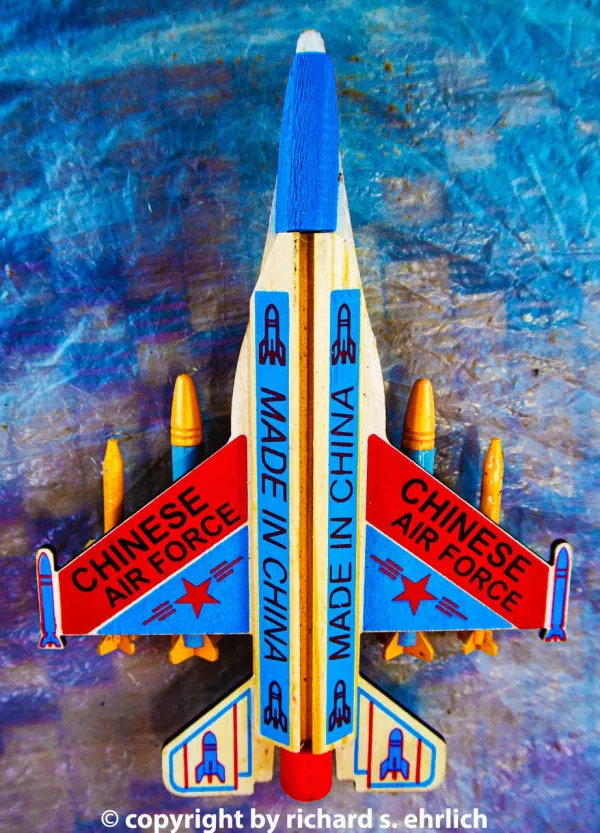
A wooden toy, handmade in China, on sale in a night market in northern Laos. Photo copyright by Richard S. Ehrlich
BANGKOK, Thailand -- China has opened its first foreign air force support center and is training pilots in communist Laos, in the latest thrust south by Beijing's military which is already training the armed forces of other Southeast Asian nations.
The location China chose in Laos was the Central Intelligence Agency's former "secret war" Lima Site 44, an isolated airstrip which helped the U.S. carpet bomb the tiny country during the regional Vietnam War which ended in 1975.
The China-Laos Joint Support and Training Center reportedly does not include a Chinese garrison or exclusive use rights.
To avoid alarming other nations, China's Defense Ministry said: "It is not directed against any third party."
Chinese engineers laid fresh concrete over Lima Site 44's rustic, red dirt airstrip during the past year to create a functioning airport with an expanded, durable runway and parallel taxiway and apron.
The new airport is in Ban Keun town near the thin Nam Ngum River in hilly, sparsely populated terrain 27 miles (44 kms) north of the Lao capital Vientiane.
The China-Laos Center began operating at the site on September 29 from a freshly built, three-story headquarters featuring dozens of airconditioned rooms, rooftop look-out platforms, telecommunications equipment, and the flags of both nations.
Lao Defense Minister Khamlieng Outhakaysone and Chinese People’s Liberation Army (PLA) officials, alongside the China-Laos Friendship Aviation Academy, inaugurated the jointly operated center.
"The center deepens practical exchanges between the two militaries, upgrading from simple equipment assistance to long-term integrated cooperation in talent training, joint exercises and equipment support," China's government-controlled Global Times reported.
"It also might help maintain stability in the Indochina Peninsula and Mekong River region, with both sides able to conduct joint search and rescue, border control, and disaster relief aviation drills under the framework.
"The center could help Laos build a systematic talent training system for pilots, ground crew and flight personnel, reducing its reliance on overseas training," Global Times reported.
Laos has a tiny air force ill-equipped for warfare.
"The Lao People’s Liberation Army Air Force operates a small fleet of fewer than 40 aircraft, mainly transport helicopters and light jet trainers, with no modern fighter jets in service," Hong Kong-based South China Morning Post reported.
Its air force "operates a small and obsolescent fleet of Chinese and Russian craft," Global Times said.
It was unclear what Chinese aircraft will maintain a presence at the airport for training Laotian pilots.
The renovated airstrip is reportedly able to support only light transport and trainer planes.
Laos enjoys good relations with all its bordering neighbors -- China, Myanmar, Thailand, Cambodia and Vietnam.
Some analysts perceive China's influence in Laos's military is a push against Vietnam's decades-long involvement in helping to run the Laotian government.
That domination began in 1975 because the victorious Pathet Lao rebels were inexperienced in the administrative affairs required to govern Laos.
China's influence in Laos is increasing.
Recently reelected Lao President Thongloun Sisoulith, who is also general secretary of the Central Committee of the Lao People’s Revolutionary Party (LPRP) -- the country's only political party -- went with his wife Naly on a state visit to Beijing in June.
After a 21-gun salute in Tiananmen Square, he met Chinese President Xi Jinping at the Great Hall of the People, followed by a feast in its Golden Hall.
The two men agreed to protect their socialist policies and communist parties, improve relations, and police cross-border crime.
Both nations support lengthening the China-Laos Railway which cuts across northeast Laos to the Mekong River border where neighboring Thailand's railway system is slowly upgrading to create a high-speed link running further south to Bangkok and the Gulf of Thailand.
Beijing is also helping impoverished Laos construct its artificial intelligence, digital economic capabilities, and hydroelectric dams.
Other sectors the two nations hope to cooperate on include exploiting Laos's valuable mineral resources, develop clean energy to stem the landlocked country's worsening air pollution, modernize its traditional farming, agree on government-controlled media coverage, and host youth exchanges.
In addition to choosing Laos for China's first foreign air force support center, Beijing also enjoys two foreign naval support centers -- one in Djibouti and one in Cambodia.
China sept up Djibouti's naval support base in East Africa at the mouth of the Red Sea, on the Gulf of Aden, in 2027.
"The concept behind the new support and training center [in Laos] is also similar to China's base in Djibouti, where training supports Chinese peacekeeping troops heading to Africa, and serves naval personnel in the Gulf of Aden," Global Times reported.
Meanwhile, Phnom Penh and Beijing established The Cambodia-China Joint Support and Training Center in 2025 near Sihanoukville at Ream Naval Base.
China expanded that southern Cambodian deep-water port for international shipping on the Gulf of Thailand which opens onto the South China Sea.
Cambodia's Ream port facilities and the Ban Keun site in Laos, "together, they cover inland airspace in the Indochina Peninsula and the maritime direction in the Gulf of Thailand," Global Times said.
China has also been training Cambodia's air, sea, and land forces in annual bilateral Golden Dragon exercises for several years.
In Thailand, China trained the army, marine corps, air force and even an aerobatic team to create colored smoke trails portraying Thailand's red, white and blue flag.
Jet fighters from Beijing and Bangkok engaged in Falcon Strike 2026's joint air force training in Thailand during August.
Falcon Strike involved "multiple types of aircraft and units, including ground-based air defense forces," China's Defense Ministry said.
The two sides trained for "joint air defense and humanitarian assistance and disaster relief."
A separate Blue Strike series of naval exercises by China and Thailand focuses on counterterrorism and disaster relief, joint maritime assaults, sniper fire, deep scuba dives and open water survival.
Geographically larger Myanmar has also engaged with Chinese in low-key "maritime security exercises."
The junta running Myanmar seized power in a 2021 coup and relies on Chinese aircraft, drones, military technology, and training against pro-democracy and separatist insurgents.
Both nations are trying to pacify minority ethnic separatists along the routes of Myanmar's valuable oil and gas pipelines and at rebel-held rare earth mines in the rugged countryside.
Beijing hopes a China-Myanmar Economic Corridor will give China’s landlocked Yunnan province a southern route across Myanmar to the Bay of Bengal.
That would enable Chinese to skip a longer far south route through the Strait of Malacca when importing oil from the Middle East.
China's military relations with Vietnam meanwhile completely flipped during the past 47 years.
In 1979, China invaded northern Vietnam but withdrew in widely perceived defeat after three weeks.
Hanoi lured the Chinese into stretching their supply lines too far south, making them too vulnerable to assaults.
Today, the two communist countries conduct joint army training along their mountainous frontier and also joint maritime exercises.
The 40th joint naval patrols in the Beibu Gulf during two days in March 2026 included anti-piracy assaults with artillery and machine guns, conducting search-and-rescue drills, and sharing intelligence.
Vietnam and China held their first-ever joint army training in July 2025.
The Hand-in-Hand exercise for ground forces in southern China's Guangxi region was for "wheeled vehicles, light arms, recon equipment, drones, protective devices and various other weapons and equipment," China's Defense Ministry said.
Lessons included "camouflage, reconnaissance, unmanned aerial vehicle reconnaissance, live-fire shooting and rescue of the wound," the ministry said.
*****
Richard S. Ehrlich is a Bangkok-based American foreign correspondent reporting news from Asia since 1978, and winner of Columbia University's Foreign Correspondents' Award. Excerpts from his two nonfiction books, "Rituals. Killers. Wars. & Sex. -- Tibet, India, Nepal, Laos, Vietnam, Afghanistan, Sri Lanka & New York" and Ehrlich's newest, "Mindfucking DeepSeek: Pushing China's AI to the Extreme" are available at
https://asia-correspondent.tumblr.com